
Grant Fundamentals: How to Create a Major Contributors Grant Attachment
Many grant applications require a list of major contributors to be submitted as an attachment, sometimes referred to as a major donors list. When you see this requirement, you may have a few questions. Here, we’ll help take some of the guesswork out of the process and offer our advice for following best practice and protecting donors’ privacy.
What is a major contributors list?
This list consists of individuals and entities that have given or will give to your organization within a specified time frame.
Is there a difference between "major donors" and "major contributors"?
For grant applications, “major contributors list” and “major donors list” typically refer to the same type of list. However, within the broader category of nonprofit development, “major donors” is often used to refer to individual donors and “funders” to refer to entities, such as foundations, churches, businesses and governments.
Is there a difference between a “major contributors list” and “sources of income”?
Yes. The major contributors list and sources of income document are two different attachments and both may be required for a grant application. A major contributors list only includes major contributors and does not reflect the total revenue for your organization. The sources of income document will show all sources of revenue, including fees and earned income, funds raised by your events, government contracts, workplace giving campaigns, and “other” income like interest. Additionally, the sources of income document typically shows each category’s percentage of total revenue, as opposed to dollar amounts.
What should I include in a major contributors list?
Your major contributors list should include the amounts contributed to your organization by foundations, businesses, churches, governments and individuals during the time period specified in the grant application. You may also choose to include in-kind donations, but this is not typically expected unless it is a significant component of your operations or is explicitly mentioned as part of the requirement.
In some cases, the grant application will require that you break out part of a category. For instance, the application may ask for a “board contributions” category showing the total amount contributed by your board.
❌ Don’t include individual donor names or funders who stipulate that their contribution is private.

What is considered a “major” donor or contributor?
The definition for “major” depends on the size of your organization and the typical contribution amount you receive from each individual or entity. As Blackbaud outlines in their Major Giving Basics, “there is no exact rule on how to qualify major gifts,” and this applies across contributor types. Blackbaud recommends setting the threshold using the average donation size from the previous year. They give the example of $500,000 total contributions from 250 contributors, for an average donation size of $2,000. In this case, donations of $2,000 and more would be considered major.
Do I need to list each major contributor individually?
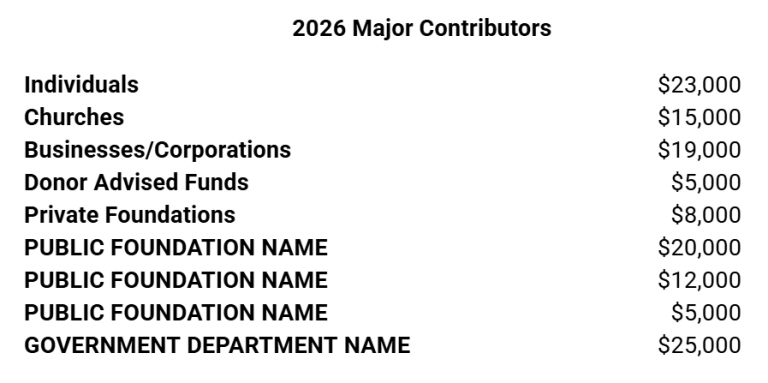
No, you do not typically need to list each major contributor and their respective contribution. In most cases, you can group the following contributions into single categories:
- Individuals
- Businesses/Corporations
- Churches
- Private Foundations
- Donor Advised Funds
Grouping these contributions into single categories preserves the privacy of these contributors.
However, if you are applying for a grant from a government, foundation or trust, it is best practice to list each public entity and their contribution to your organization (unless the entity stipulates that their contribution should remain private). This would include:
- Foundations
- Governments
Ultimately, your list might look like this:
How do I create a major contributors list for the current year?
In some cases, grantmakers want to see your projected contributions for the current year – but you don’t have a crystal ball! What should you do?
In this instance, your organization’s current year budget should have anticipated amounts in each of the main revenue categories that you can pull for the major contributors list. If it does not, huddle up with relevant staff and board members (such as your finance committee) to analyze:
- Historic revenue in each category (individuals, churches, businesses/corporations, foundations, etc.).
- Anticipated growth in these categories in the current year.
Make sure that your projections ultimately match your total budget for the current year.
Once you’ve calculated the total amounts for each category and listed those in your major contributors list, you want to highlight the specific foundations and government entities you will approach for funding this year. List the grantmakers you plan to apply to and the respective amounts you will request, and note any requests that are already awarded or currently pending. Your grants list might look like this:

What if the grant application doesn’t specify a time period for the major contributors list?
Typically, the grant application will specify the time period for the major contributors list. If it does not, our practice at L Pro is to include the prior fiscal year’s major contributors list. It is also helpful to include a note about your expectations for the current fiscal year’s major contributors (e.g., we expect similar contributions, we expect growth in contributions, we will diversify revenue, etc.) and list the grantmakers you will approach this year with the respective amounts you will request and indications for those already awarded or currently pending.

Why do grantmakers want a major contributors list?
Grantmakers often use major contributors lists to evaluate your organization for:
Endorsement by your community: If individuals and local foundations, businesses and governments are contributing to your organization, this reflects endorsement of your organization within your community. It shows that your community sees the need for your programs and/or services, and that they believe you are meeting that need appropriately.
Diversified sources of revenue: Grantmakers want to see that you receive funds from multiple different types of sources. It is more sustainable to rely on various sources of support as opposed to relying on one or two contributors, in case one of those contributors is unable to support your organization in future years.
Consistent support and growth: In some cases, a grant application will ask to see major contributors lists for multiple years. These lists can be very revealing. For instance, if you’ve received funds from a public foundation for multiple years, that demonstrates that you’re accomplishing your goals and satisfying grant reporting requirements year after year. It could also demonstrate your organization’s growth, improved development strategy, and diversification of funding over time.
At L Pro, we regularly provide our clients with guidance and support related to grant attachments. Though they may seem like a tedious “extra” step, they help funders get a holistic view of your organization, operations and impact. And the hard truth is: Your application could be immediately disqualified if you don’t provide the correct attachments. In some cases, grantmakers are gracious enough to reach out and request the documents they need. But most don’t have the time or resources to backtrack. It truly “pays” to give attachments a second thought before submitting.
If you’re looking for professional guidance related to your grant program, reach out to us at info@lprowriting.com to schedule a one-hour fit call/consultation. And subscribe to our newsletter for more advice like this!