Diversifying Funding for Nonprofits: Where to Start
April 21, 2026
L Pro Team
Diversifying Funding for Nonprofits: Where to Start
What led you to this page today?
“We’re too reliant on government grants and we need to diversify funding.” – Board of Directors
“We like for our grantees to have a more diverse funding mix.” – Major grantmaker
“You experienced a dramatic loss in your primary funding source category and you need to make up a deficit – ASAP.” – Financial statements
Regardless of what landed you here, we have some quick insights to help you evaluate your current funding mix and determine which additional funding or revenue streams could work for your organization.
What does it mean for a nonprofit to have diverse funding and revenue?
It simply means that your organization receives funding and revenue from multiple source types, as opposed to relying primarily on one source type. It also means diversity within your funding categories, such as having support from multiple foundations or having multiple individual donors.
Types of funding sources for nonprofit organizations include:
Individual Donors
Donor Advised Funds
Foundations and Other Non-Governmental Granting Entities
Government Grants
Corporations
Workplace Giving
Churches
Events Income
Event Sponsorships
Government Contracts
Program Fees/Revenue
Investment Income
Social Enterprise Income
Membership dues/income
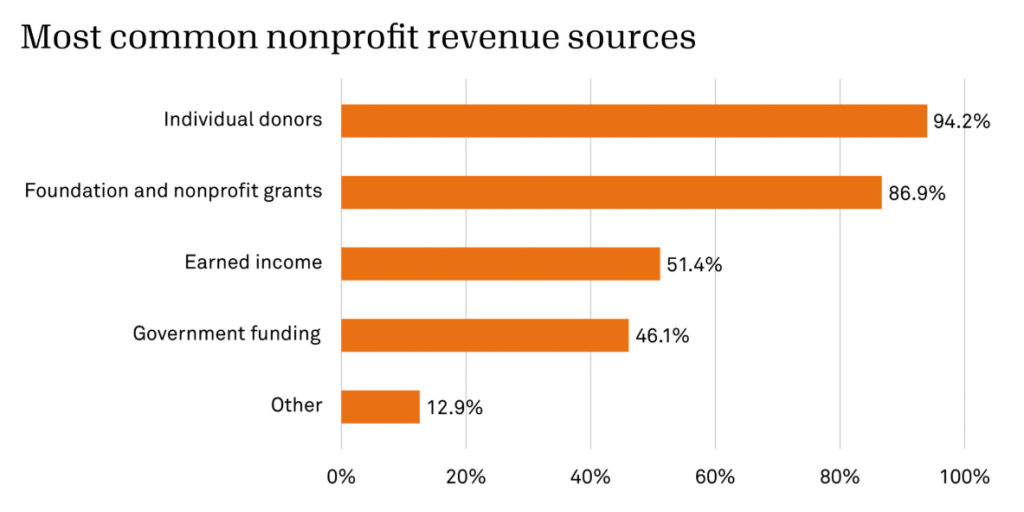
According to recent data from Candid, individual donors are the most common revenue source.
Candid Data & Insights
Why is it important for nonprofits to diversify funding?
Nonprofits with diverse funding mixes are often more sustainable and resilient. If you’re overly reliant on one funding source, you’d be in a pinch if that source took a hit.
For example, federal funding cuts and disruption in 2025 had a devastating impact on nonprofit organizations across the country. Many had to decrease their staff, programs, locations and numbers served (Urban Institute).
The sustainability and resilience of diverse funding goes beyond financial statements and spreadsheets. It also means your organization has a variety of partnerships, relationships and stakeholders. You have a blend of resources building you up, supporting you, collaborating with you, and even leaning on you for the support you bring to the table.
What does a healthy funding mix actually look like in the nonprofit industry?
This is one of the top questions nonprofit leaders ask, and it’s a hotly debated topic in the industry.
The general consensus is: there is no exact formula for a healthy funding mix.
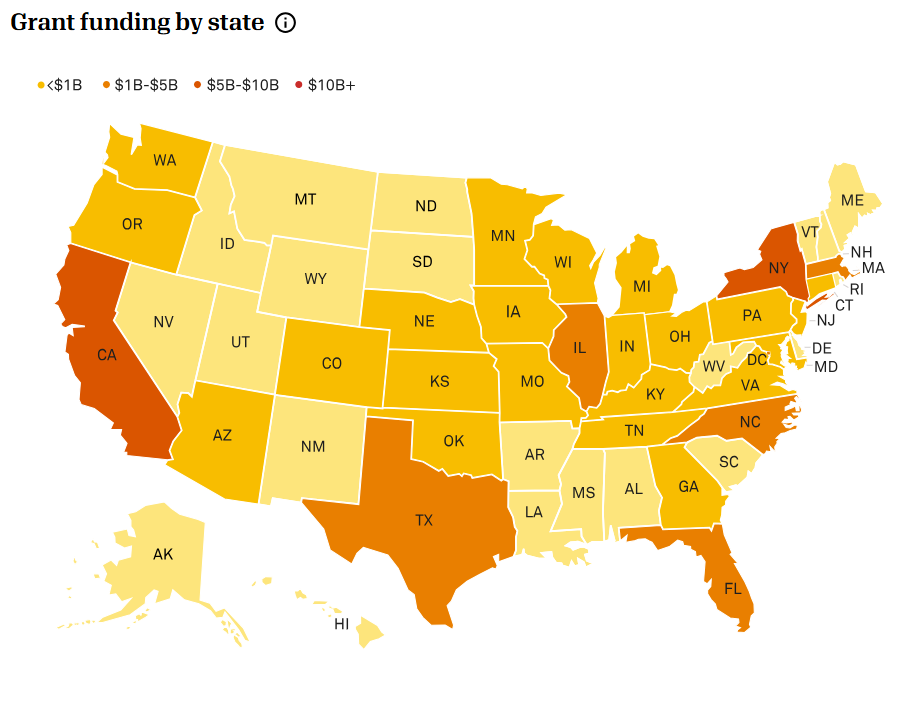
The ideal mix depends on your mission, programs, strengths, capacity, financial infrastructure, geographic area, and so much more. Take this data from Candid for example:
Candid: US Social Sector - Money
In this infographic that shows grant funding by states, nonprofits in states where grant funding is less than $1B might not have as much success as those where it’s greater than $10B.
However: It depends! It depends on what grantmakers in your state want to fund, your organization’s capacity to manage grants, the competitiveness in your cause area, and more.
Data like this can be very helpful in driving your decisions, and we encourage you to research how different funding streams and mixes perform for organizations of your size, in your industry sector and in your geographic area.
How to lay the groundwork for diversified funding
Grab a piece of paper or open a word document and use this questionnaire to start the process of developing your funding diversification strategy. With every consideration you make, be sure to ask yourself: Does this align with our mission?
1) What does your current funding and revenue mix look like?
Which funding sources are represented and what percentage does each represent? How many are represented?
2) Are you overly reliant on a single source of funding?
“Overly reliant” meaning, if that source were to dry up, would you be forced to shut down some or all programming immediately?
3) How are your current funding sources performing?
How much time and effort does it take to manage it?
Does it have the potential to grow with additional care and attention?
Is it taking up more resources than the value it provides?
4) Are any of your funding sources at risk?
There are several risks to look out for:
Has this funding source been declining over time?
Is it at risk of being cut or reduced, such as with federal funding?
Are there large funding sources you’re not strategically managing?
5) Are there any promising funding sources with zero representation in your mix?
Think of funding streams that would make sense for your organization that aren’t in your mix.
For instance, if you’re a faith-based nonprofit without a church giving category, that would be an ideal new funding stream for you and it’s probably worth exploring how to develop a funding strategy around that.
If you’re a small nonprofit without any corporate giving or connections with local and regional businesses, your approach to this funding stream might be more experimental, but there’s a chance it could pay off if you are strategic and there’s interest from those businesses.
6) What resources are already in place to develop a new funding stream?
What expertise do your team members have that could be helpful in growing a specific funding stream, such as event management or grant management? What affiliations and connections might your employees, board members, volunteers, constituents, partners and stakeholders have that could jump-start a new funding initiative?
This is only the beginning, but if you’ve answered these questions, you’ve already made substantial progress.
For next steps, we encourage you to bring the information you’ve compiled about your funding mix to your next board meeting. You aren’t alone in this. Board members are key collaborators, and they may have ideas, as well as affiliations and associations, that could tip the scales as far as which funding source offers the most promise.
If you’re considering grants as a funding source and are looking for professional guidance, reach out to us at info@lprowriting.com to schedule a one-hour fit call/consultation. And for more insights like this, subscribe to our quarterly newsletter.